
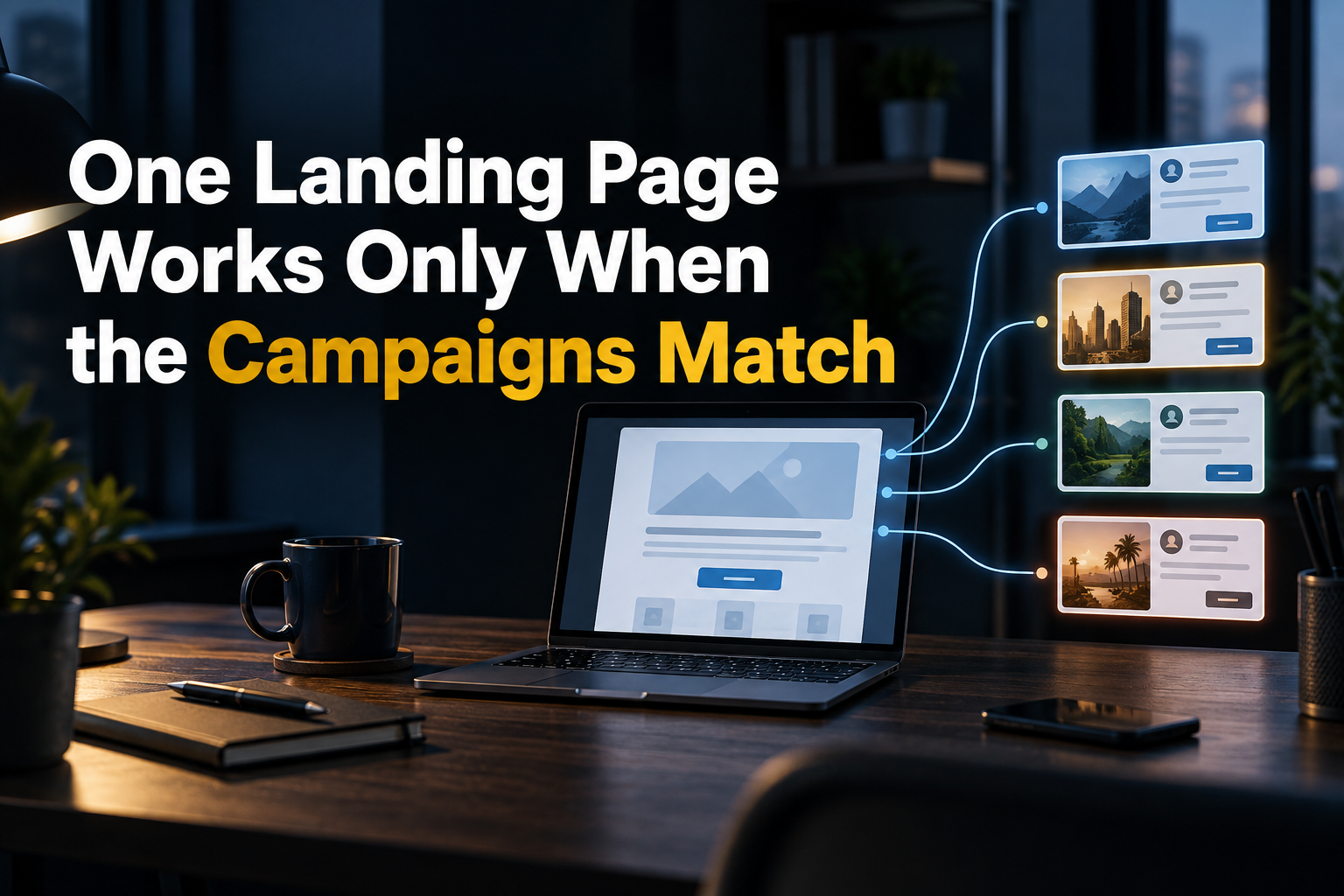
One landing page can serve several advertising campaigns, but only when those campaigns make essentially the same promise to the same kind of customer. If the audience, offer or next step changes, a shared page usually asks visitors to sort through information that does not apply to them.
The practical question is not how many ads point to the page. It is whether every visitor arrives with similar expectations and can quickly find a clear reason to act.
Start With the Visitor’s Intent
A person who clicks an ad for emergency service has different needs from someone comparing long-term maintenance plans. Even if both campaigns promote the same company, they should not force visitors through the same general explanation.
Google Ads recommends choosing a landing page that closely matches the ad and keyword themes. Its current guidance also emphasizes useful original information and easy navigation. That is a good standard for any ad platform: the page should continue the conversation the ad started.
Use the Six-Part Match Test
A shared page is reasonable when the campaigns align on six points:
- Audience: The same people are being addressed.
- Intent: Visitors are trying to solve the same problem.
- Offer: The product, service or promotion is the same.
- Geography: The business serves the same locations.
- Proof: The same examples, qualifications or testimonials are relevant.
- Action: Every visitor should take the same next step.
If two or more of these points differ, a dedicated page will usually make the decision clearer.
Shared Pages Fit Closely Related Campaigns
One page may work for separate search and social campaigns promoting the same seasonal service in the same market. It may also work when ads use different creative approaches but lead to one offer, one audience and one call to action.
The page still needs a headline that makes sense after every ad click. Avoid squeezing several campaign messages into rotating banners or long blocks of choices. A shared page should feel focused, not merely flexible.
Dedicated Pages Make Differences Easier to Measure
Use separate pages when campaigns target different industries, locations, services or stages of the buying process. A dedicated page lets you change the headline, proof, form and next step without weakening another campaign.
It also improves measurement. When each campaign has a distinct path, owners can compare qualified inquiries and completed actions instead of relying only on clicks or page views.
Fix the Page Before Multiplying It
Do not build more pages simply to appear sophisticated. First make sure the offer is clear, the page works well on a phone, the form is reasonable and tracking is reliable. Then create a dedicated version only when a meaningful campaign difference requires it.
Questions Business Owners Often Ask
Does every ad group need its own landing page?
No. Closely related ad groups can share a page when their audience, promise and desired action match.
Can the home page be a landing page?
It can, but home pages often present too many choices. A focused service page is usually easier for an ad visitor to understand.
Should location campaigns use separate pages?
Use separate pages when services, proof, availability or calls to action differ by location. Do not create nearly identical pages with no useful local information.
What should we measure?
Track completed forms, calls, purchases or other meaningful actions. Compare lead quality and cost, not just traffic.